
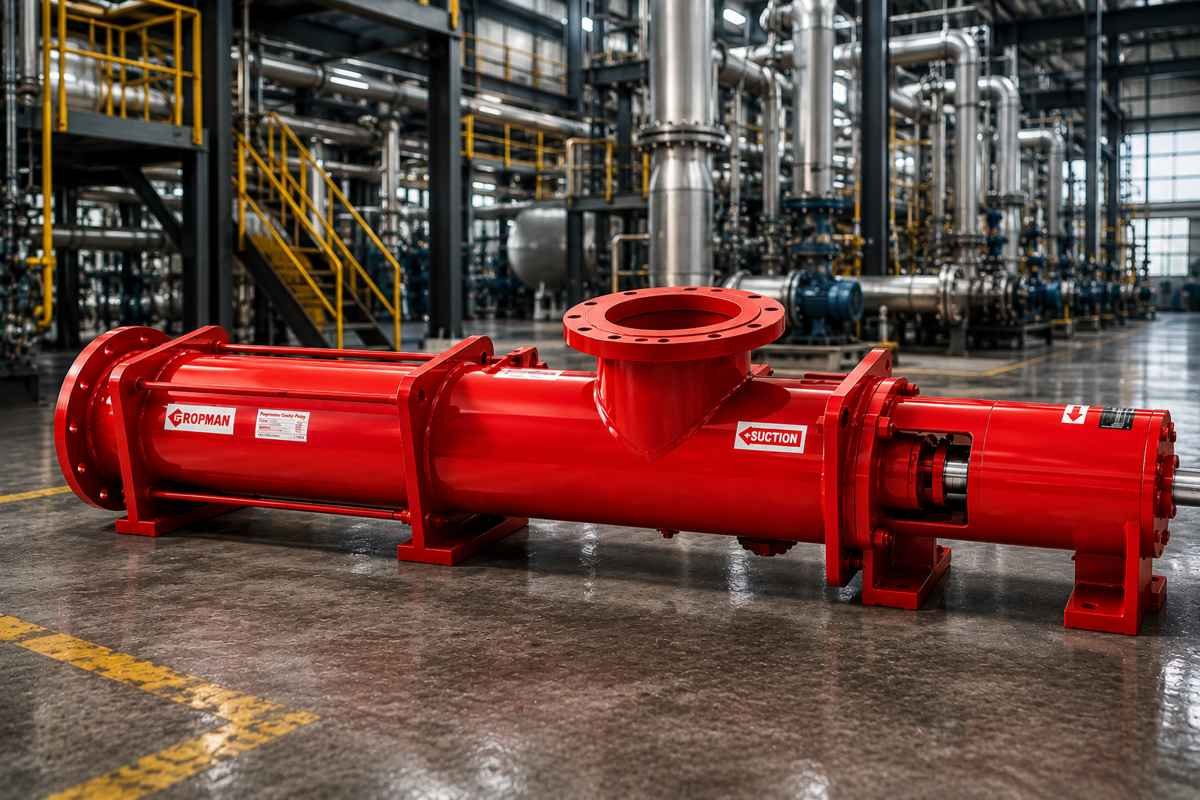
A progressive cavity pump (PC pump) is one of the most versatile and efficient positive displacement pumps used in modern industry. Whether you are transferring thick molasses in a sugar mill, precise chemical dosing in a pharmaceutical plant, or handling sludge in a sewage treatment facility, a progressive cavity pump delivers smooth, consistent, low-pulsation flow that centrifugal pumps simply cannot match.
This complete guide by Ropman Pumps — India’s trusted PC pump manufacturer since 2000 — explains exactly what a progressive cavity pump is, how it works, what types are available, and which industries rely on them every day.
What Is a Progressive Cavity Pump?
A progressive cavity pump, also known as a progressing cavity pump, eccentric screw pump, single screw pump, or PC pump, is a type of positive displacement pump. It was invented by René Moineau in the 1930s and works on the Moineau principle: a helical rotor turns eccentrically inside a double-helical elastomeric stator, creating a series of sealed cavities that move (“progress”) from the inlet to the outlet, carrying fluid with them.
Key Terminology
- Progressive Cavity Pump = PC Pump = Progressing Cavity Pump = Eccentric Screw Pump
- Rotor: Hardened steel helical screw — the rotating component
- Stator: Elastomeric double-helix housed in metal casing — the stationary component
- Cavity: The sealed space between rotor and stator that carries fluid
How Does a Progressive Cavity Pump Work?
The working principle of a progressive cavity pump is straightforward but highly effective:
- Step 1 — The motor turns the rotor inside the stator via a connecting rod and universal joint.
- Step 2 — The eccentric rotation of the helical rotor within the stator creates a series of sealed cavities at the suction inlet.
- Step 3 — These cavities fill with fluid from the inlet and travel axially (progressively) through the pump body toward the discharge outlet.
- Step 4 — Fluid is discharged continuously at the outlet. The flow rate is directly proportional to rotor speed.
Because fluid is enclosed in discrete cavities and moved gently, PC pumps apply minimal shear — making them perfect for fragile, viscous, or abrasive materials.
Key Performance Characteristics
- Flow rate: Proportional to RPM — easy to control with a VFD (Variable Frequency Drive)
- Pressure: Single-stage to multi-stage; up to 36 bar with Ropman high pressure models
- Viscosity range: From thin water-like fluids up to extremely viscous pastes
- Solids handling: Can pass soft or abrasive solids without damage
- Self-priming: Can run dry for short periods (with appropriate stator material)
- Bidirectional: Reversal of rotor direction reverses flow direction
Types of Progressive Cavity Pumps
1. Horizontal Progressive Cavity Pump
The most common configuration. Ideal for general-purpose industrial use, horizontal installation, and easy maintenance access.
2. Vertical Progressive Cavity Pump
Used in applications requiring a small floor footprint or where suction conditions demand a submerged inlet.
3. High Pressure Progressive Cavity Pump
Multi-stage design capable of generating pressures up to 36 bar. Used in grout injection, chemical injection, and pipeline applications.
4. Sanitary / Hygienic Progressive Cavity Pump
Used in food, beverage, cosmetics, and pharmaceutical applications where CIP (Clean-In-Place) capability and FDA-compliant materials are required.
5. Open Hopper Progressive Cavity Pump
Designed for highly viscous or thick materials (pastes, sludge, press cake) that cannot flow by gravity to a standard inlet.
Industrial Applications of Progressive Cavity Pumps
- Sugar & Distillery: Molasses transfer, fermented wash pumping
- Food Processing: Fruit pulp, ketchup, batter, dairy products
- Pharmaceuticals: API dosing, syrup transfer, cream pumping
- Wastewater Treatment: Primary sludge, digested sludge, polymer dosing
- Oil & Gas: Crude oil transfer, drilling mud, grout pumping
- Chemical Industry: Acids, alkalis, adhesives
- Paper & Pulp: Stock and pulp slurry transfer
- Cosmetics: Lotions, creams, hair gels
Advantages of PC Pumps Over Centrifugal Pumps
- Handles high-viscosity fluids that centrifugal pumps cannot
- Gentle low-shear action preserves fluid integrity
- Self-priming capability
- Operates effectively with entrained gas/air
- Handles solids-laden fluids without clogging
- Predictable, consistent flow with no pulsation
Ropman Progressive Cavity Pumps — Made in India, Trusted Globally
Ropman Engineering Corporation, Meerut, has been manufacturing progressive cavity pumps since 2000. With in-house rotor and stator production under ISO 9001:2008 quality standards, Ropman PC pumps are used across sugar mills, distilleries, pharmaceutical plants, food processing units, and sewage treatment facilities across India.
Whether you need a standard horizontal PC pump, a high-pressure model, or a custom solution for an unusual fluid, Ropman’s engineering team can design and deliver the right pump for your application.